ruby@hgqyplastic.com



How to Choose the Right PVC Rigid Sheet Roll for Packaging

Choosing a pvc rigid sheet roll for packaging means matching five factors to your application: thickness or gauge, clarity, impact resistance, food-contact compliance, and cost. Compare the full set of specs—thickness, width, length, tensile strength, and temperature range—across the rolls you are considering. A pvc option that fits your line and product beats a cheaper, thicker alternative.
Key Takeaways
Pick the PVC roll's thickness, clarity, and impact resistance to fit what you need for your packaging.
Check that the roll meets food-contact rules and has the right recycling codes before you buy.
Look at the total cost over time, not just the purchase price, to get the best value.
PVC Rigid Sheet Performance Factors
Thickness or Gauge Selection
Thickness or gauge is the first spec to lock down. Thin firm gauges from 0.004" to 0.0075" work well for lightweight packaging, covers, badge holders, and document overlays that need a thin yet rigid sheet. Heavier gauges fit more demanding applications. Match the gauge to your converting process, because a thickness that works in thermoforming may fail in HF welding. Specify gauge and plasticizer content together, since flexibility depends on both. Factor thickness tolerance into cost, because a nominal gauge with a wide tolerance can arrive below your required thickness. Thicker film does not automatically improve quality; it mainly adds cost. A well-formulated thinner film can outperform a thicker one with inconsistent plasticizer content. A properly specified 0.25 mm film often performs identically to a 0.30 mm film while costing 15–20% less. Ask for a thickness recommendation based on your actual converting conditions instead of defaulting to the heaviest option. Remember that thicker films make heavier rolls with fewer linear meters per kilogram, which raises freight cost per square meter.
Clear PVC Vinyl Film and Impact Resistance
Clarity and impact resistance work together in packaging. Clear PVC vinyl film helps products stay visible, and rigid PVC resists crushing better than standard paperboard. PVC foam board also gives greater durability, weather resistance, and structural rigidity than paper or cardboard. Check tensile strength alongside these properties. Clear PVC vinyl film for industrial and packaging use typically shows 2500–4000 PSI, and ASTM D882 testing reports 15–28 MPa for flexible film and 40–55 MPa for rigid film. Temperature range deserves the same check. Compare thickness, width, roll length, tensile strength, and temperature range as a set, not in isolation. This selection approach protects performance across the whole rigid sheet, not just one number on the datasheet.
Over-specifying thickness is a common mistake. Request a thickness recommendation based on actual converting conditions rather than defaulting to thicker film.
Matching PVC for Packaging to Applications
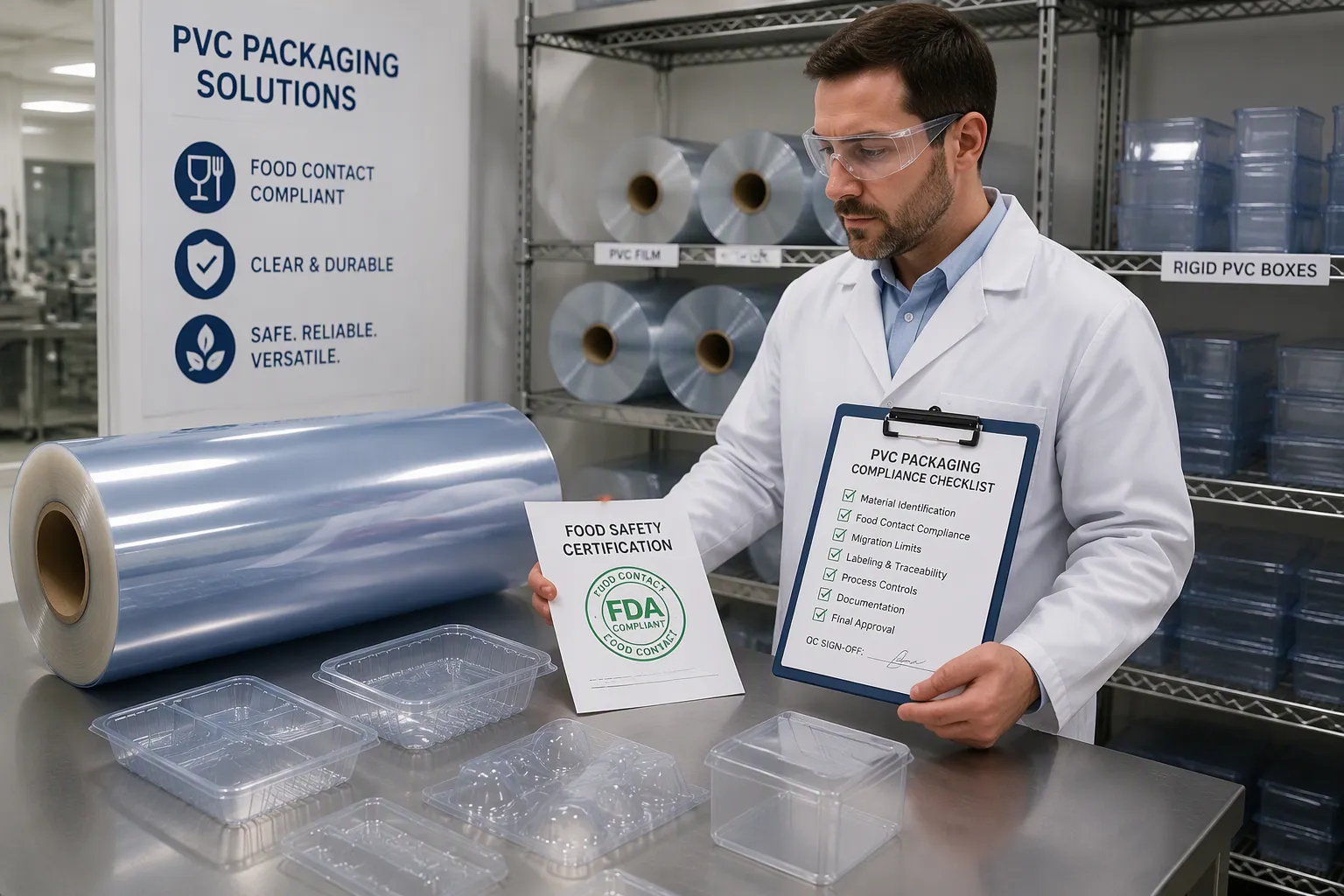
Application Fit by Packaging Type
Begin with how the film will be used. Decide if it will face weather, chemicals, or food. Then match the film's features to that use. A clear pvc vinyl film works well for store displays, while a UV-resistant grade is better for sun exposure. This step helps you avoid paying for features you don't need.
Application fit then helps you narrow your choices. Clear or shrink PVC films work for packaging, while UV-resistant and heat-resistant films fit car uses. Rigid PVC boxes give you visibility and crush resistance that printed cartons cannot. Common packaging uses for a rigid pvc sheet include blister packaging, clamshells, and shrink wraps. A blister sheet needs a steady gauge for clean forming. A clear pvc film for a shrink wrap needs balanced shrink tension. Clear pvc vinyl for a folding carton window needs to crease well. Each use pulls the same base material toward different features.
Food-Contact Compliance and Recycling Codes
Compliance decides whether a roll can enter your market at all. Confirm food-contact suitability before you commit to a supplier. Food-safe unplasticized PVC (uPVC) is made without harmful chemicals and is recommended for food packaging uses such as tamper-resistant medicine packaging and shrink wraps. Its strength, chemical resistance, flexibility, and oil resistance make it suitable for food uses that need protective barriers, although its recyclability remains limited. PVC films can be either rigid or flexible and offer strong barrier properties. They are durable and versatile but raise environmental concerns about production and disposal. Food packaging uses include blister packs, cling wrap, and shrink films.
Ask for written proof of the standards your market requires. A supplier statement such as this one gives you a clear benchmark:
The finished product meets the US FDA and Japanese PL food hygiene standards.
Check the recycling code on the roll as well. Industrial rolls follow a different logic. Choose these by performance needs such as stretch ratio and puncture resistance rather than consumer-grade criteria. A rigid PVC sheet for industrial use may never touch food, so barrier and hygiene claims add cost without benefit. Match the compliance level to the end use, and keep the paperwork on file for each batch.
Cost, Customization, and Supplier Choice
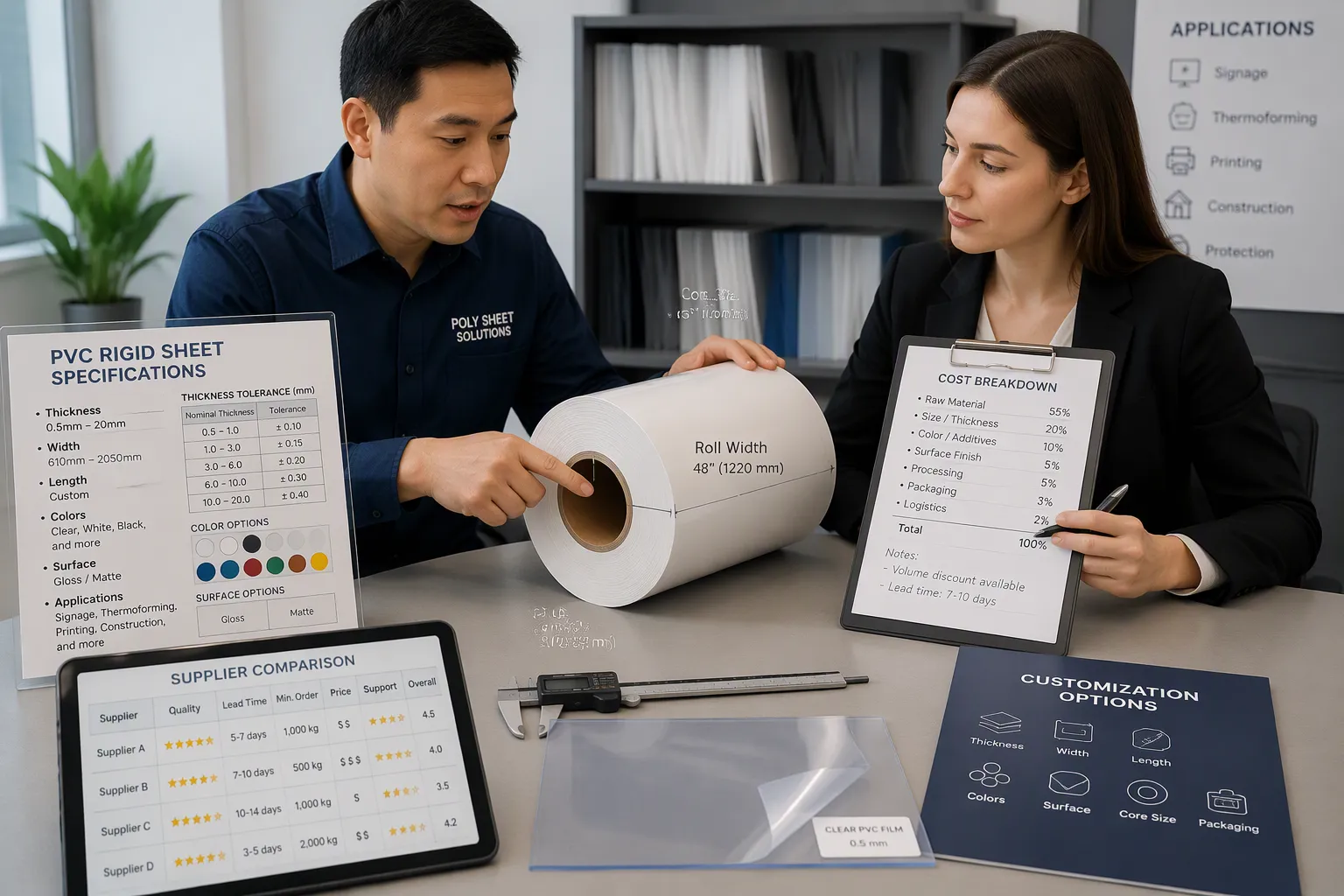
Customization Options and Pricing Drivers
You can adjust PVC film to fit your machine. Thickness tolerance, roll width, core size, hardness, and surface finish all change the price and the fit. A tight tolerance on a thin gauge costs more than a loose one, so state the tolerance your line really needs. Roll width and core size must match your unwind stand, or the roll will not run. Surface finish matters for clear pvc film that carries printed graphics.
Material selection also means matching K-value and pvc grade to the intended use. A sheet grade built for thermoforming will not work the same in HF welding. Buying from a quality supplier keeps each batch consistent. Ask for the pvc grades on offer and the test data behind them.
Weighing Budget Against Performance
Judge a roll by total cost of ownership, not sticker price. Include scrap rates, rework labor, and warranty claims in your analysis.
For a Moscow office building, a 15-year total cost of ownership was calculated: PVC roll required rebuffing every 18 months and seam repairs, adding 30% to its initial price. The SPC alternative, though 20% more expensive at purchase, ended up costing 25% less over the lifespan.
Cost Factor
What to Consider
Initial cost
Material, accessories, and applicable installation costs
Routine maintenance
Cleaning frequency, products, equipment, and labor
Repairs
Ease of replacing damaged sections
Replacement
Expected service life and partial or full replacement cost
Downtime
Disruption during repairs, maintenance, or replacement
Product availability
Matching products for future repairs or expansion
Weigh purchase price against energy consumption, maintenance costs, spare parts availability, and productivity. Raw material procurement is the main recurring cost, and material efficiency directly affects profitability. Energy costs over 5–10 years can rival the original machine price. Downtime is the hidden multiplier. The best rolls fit your packaging applications and compliance needs at a workable budget, not simply the cheapest or thickest option.
Start by defining your packaging application. Then shortlist each pvc rigid sheet by gauge, clarity, and impact resistance. Next, check food-contact compliance and recycling codes. Compare customization and cost last. The right roll fits your application and compliance needs at a budget you can manage, not the cheapest or thickest option. Ask for samples and spec sheets before you order a full roll of pvc for packaging.
FAQ
Which gauge should you start with for a new packaging line?
Start with the thin firm range of 0.004" to 0.0075" for lightweight packaging. Run a trial on your line first. Your thermoforming results will show whether you need a heavier gauge.
Does a heavier gauge always give better performance?
No. A well-formulated thin sheet can outperform a thicker one with inconsistent plasticizer content. Match the gauge to your converting conditions. Over-specifying adds cost without adding value.
How do you confirm food-contact compliance before ordering?
Ask for written proof of the standards your market requires, such as FDA or Japanese PL food hygiene compliance. Check the recycling code on each roll. Keep the paperwork on file for every batch.


Recent News
1.PVC sheet supplier: PVC vs PETG material comparison for 2026 applications
2026-09-022.Where Can I Find Transparent PVC Sheets? A Complete Sourcing Guide for 2026
2026-08-203.Rigid PVC Sheets for Industrial Applications: From Lamp Shades to Cooling Tower Fill
2026-09-144.The lifespan of a 4x8 PVC sheet
2026-02-10