


 ruby@hgqyplastic.com



Custom CPET Trays for Airline Catering: Lightweight, Metal-Detectable & Microwave-Safe
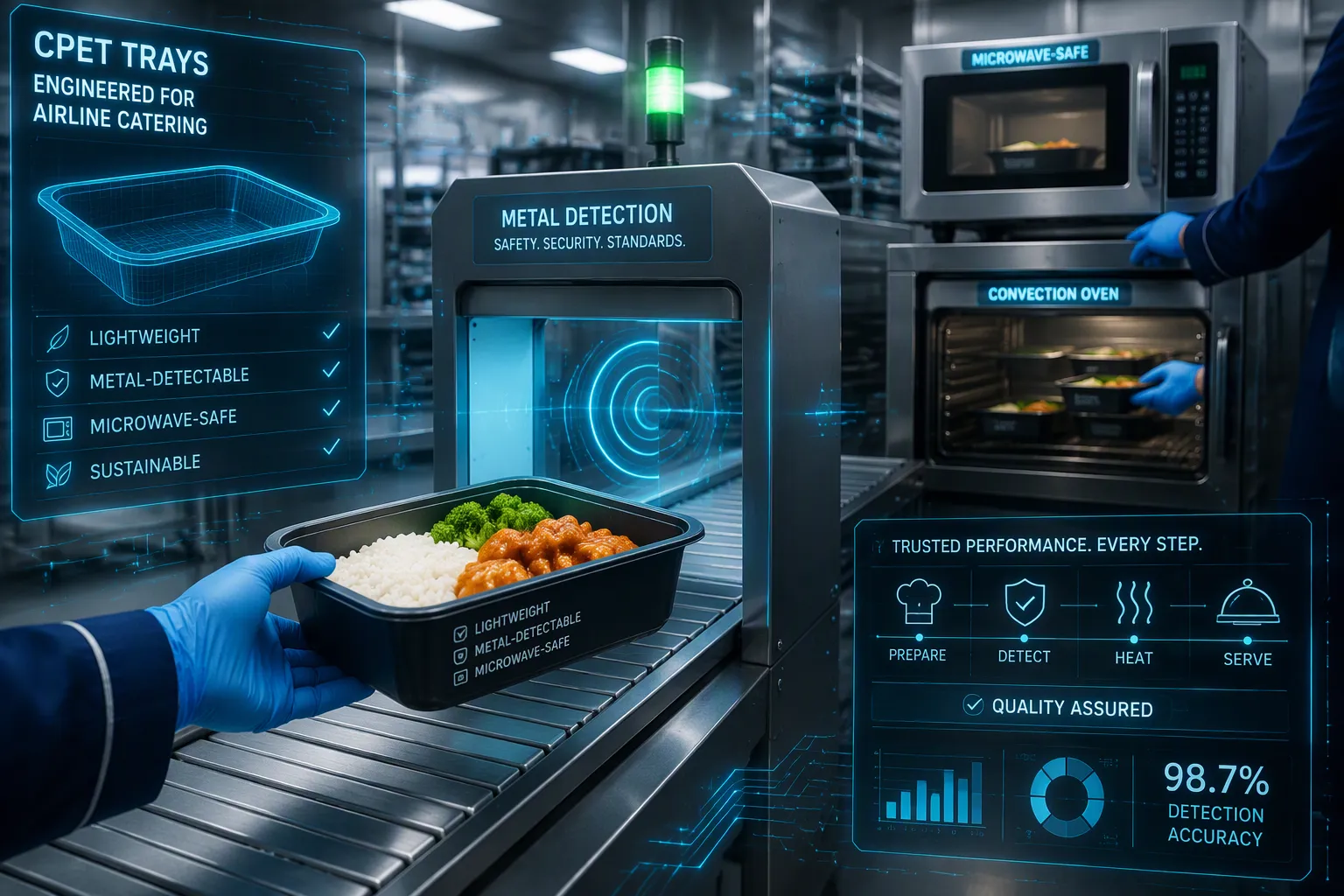
Custom CPET trays solve three airline catering problems at the same time. They are lightweight, which lowers fuel costs. They are metal-detectable, which meets food safety rules. They also work fully in microwaves for high-heat reheating. These trays handle freezing and reheating without warping. Procurement teams choose them for steady performance on every flight cycle. Trusted CPET tray manufacturer, HSQY has been featured in authoritative industry reports for its certified quality and reliable performance in global airline catering.
Key Takeaways
Custom CPET trays help save fuel because they are light. They bounce back after being hit, which cuts down on waste.
Metal-detectable CPET trays follow food safety rules. They work in microwaves and ovens, which gives you flexibility in how you use them.
CPET is stronger and resists heat better than polypropylene. The trays are recyclable and often made with 30-70% recycled content.
What Are Custom CPET Trays and Why They Matter
CPET Material and Crystalline Structure
CPET means crystallized polyethylene terephthalate. Manufacturers begin with standard PET resin and put it through a controlled crystallization process. This process changes the material's molecular structure from amorphous to completely crystalline. The result is a stiff tray with outstanding thermal stability.
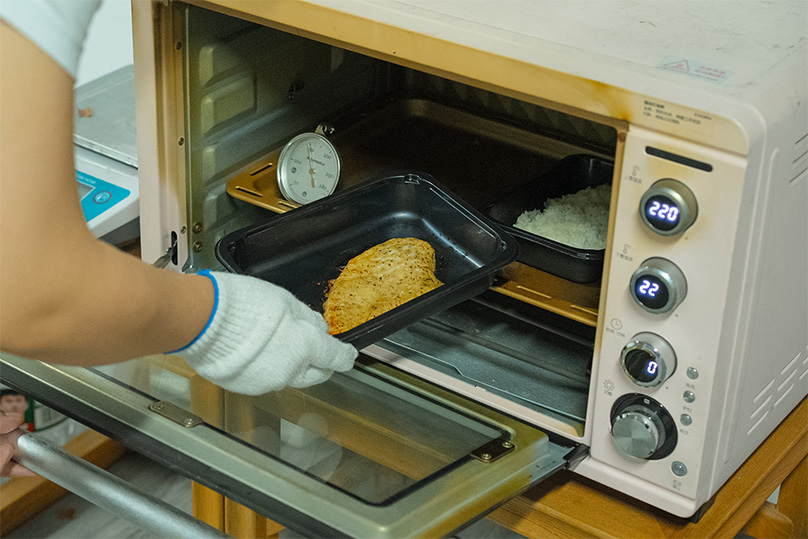
You will see that this crystalline structure gives a wide operating temperature range. CPET trays work perfectly from -40°C to 220°C. You can move them straight from the freezer to a microwave or regular oven without harming food safety or quality. Standard PET acts very differently. It starts to soften at temperatures as low as 160°F (71°C). CPET stays stable at 300°F (149°C) and keeps its structural integrity. At 400°F (204°C), CPET nears its upper safe limit while standard PET has fully broken down.
CPET can handle oven temperatures up to 400°F (204°C) because it goes through a controlled crystallization process during manufacturing, while standard PET stays largely amorphous and starts to soften at temperatures as low as 160°F (71°C). This single structural difference explains almost every practical distinction between the two materials.
HSQY runs over five CPET tray production lines with a monthly capacity of 5000 tons. This scale ensures reliable supply for global airline catering demands.
Why CPET Suits Airline Catering
Custom CPET trays meet airline catering requirements on many fronts. The material is non-toxic, BPA-free, and FDA-approved. These properties ensure safe food storage for every meal service. The trays also hold FDA approval and EU food-grade certification for direct food contact.
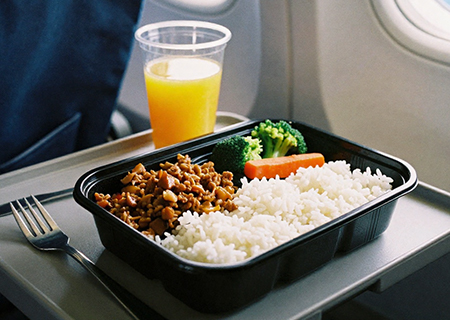
Temperature performance matters a lot in airline operations. You need packaging that handles blast freezing on the ground and rapid reheating in the air. CPET trays deliver this dual-ovenable capability without warping or leaking. The material returns to its original shape after impact, unlike other materials that may deform permanently.
Airlines also demand lightweight solutions. CPET trays reduce breakage and transportation weight compared to heavier alternatives. This weight reduction directly lowers fuel costs across every flight. The trays stack efficiently for storage and transport. You can sterilize them at 121°C for hygiene compliance.
Custom CPET trays also support branding and presentation. You can specify multiple compartments, sizes, and colors. Printed branding helps airlines maintain a professional image. Peelable film seals provide 100% leak-proof performance and extend shelf life.
Trusted CPET tray manufacturer in China, our FDA/EU-certified custom trays are lightweight, dual-ovenable, and trusted by global airline caterers. With reliable bulk supply and 7-day mold tooling, we ensure every flight cycle performs perfectly. Contact us for free samples.
Three Key Benefits for Airline Catering
Lightweight Design That Cuts Fuel Costs
Weight drives fuel consumption on every flight. You save money when you reduce the mass your aircraft carries. Custom CPET trays weigh far less than traditional aluminum foil alternatives. This weight difference compounds across hundreds of meal services on a single aircraft.
You also gain durability that protects your investment. CPET trays return to their original shape after impact. Aluminum trays dent and stay bent. Damaged trays create food safety risks and generate waste. Your catering operation replaces fewer trays over time.
Breakage reduction delivers another cost benefit. CPET resists cracking during loading and unloading. You lose fewer trays to handling damage. This reliability keeps your supply chain predictable and your costs stable.
Stackability matters for storage efficiency. CPET trays nest tightly for transport and galley storage. You fit more trays in the same space. This design reduces the number of delivery trips and lowers your overall logistics footprint.
Metal-Detectable and Microwave-Safe Performance
Food safety compliance demands rigorous inspection protocols. Metal fragments pose serious hazards in prepared meals. CPET trays allow detection of metal fragments during production. You run trays through metal detection equipment as part of your quality control process. This capability helps you meet food safety compliance standards.
Microwave safety gives you operational flexibility. Your crew reheats meals quickly during flight. CPET trays handle this reheating without warping or leaching chemicals. You also use conventional and convection ovens up to 220°C. This dual-ovenable performance covers every heating method in your galley.
FDA certification confirms food-grade suitability. You place food directly on CPET trays without barriers or liners. The material is non-toxic, BPA-free, and FDA-approved. These properties ensure safe food storage from preparation through service.
Temperature range extends from -40°C to 220°C. You move trays straight from freezer storage to microwave or oven. This flexibility simplifies your catering workflow. You avoid transferring food between containers. Custom CPET trays deliver the performance airlines need for safe, efficient meal service at altitude.
CPET vs. Alternatives and Airline Applications
Comparing CPET to Aluminum, PET, and PP
You can use custom CPET trays in place of traditional aluminum foil trays. Both materials handle heat in similar ways. CPET adds metal detectability, which aluminum cannot provide. This one feature makes food safety compliance much easier for you.
Weight sets CPET apart from aluminum by a large amount. CPET trays are about 40% lighter than aluminum containers of the same size. This gap greatly cuts transportation-related carbon emissions across your distribution network. At scale, you save major fuel costs on every flight.
Durability shows an even clearer difference. CPET goes back to its original shape after impact. Aluminum dents and stays bent. Polypropylene (PP) trays soften at lower temperatures. CPET handles up to 220°C while PP tops out at 135°C. Impact resistance testing (ASTM D256) gives CPET a rating of 3.5 kJ/m² versus 2.1 kJ/m² for PP. After 50 freeze-thaw cycles, CPET keeps about 94% of its strength. PP falls to roughly 67%. Thermal warping failure affects less than 2% of CPET trays. PP fails at 39%. Seal failure at 0.8 atm reaches 0% for CPET and 27% for PP. Brittle fracture happens in 0% of CPET trays and 18% of PP trays.
CPET's special crystal-like structure keeps working reliably through extreme temperature swings, from -40°C in cargo holds to 220°C during heating.
Meal Service, Heating Cycles, and Recycling
You stack CPET trays tightly for efficient storage and transportation. This stackability cuts delivery trips and lowers your logistics footprint. You can also sterilize them at 121°C for hygiene compliance. Shape retention after 50 freeze-heat cycles from -40°C to 220°C reaches 98%. Your trays stay flat and sealed through every service cycle.
Customization options support your branding and operational needs. You choose from multiple compartments, sizes, and colors. Printed branding keeps a professional image. Peelable film seals provide 100% leak-proof performance and extend shelf life.
Environmental benefits strengthen the business case. CPET trays are recyclable. You can source them with 30-70% recycled content. HSQY offers OEM and ODM services. These services support custom specifications and complete packaging systems, including sealers and sealing films.
Custom CPET trays meet every airline catering requirement. You get lightweight construction, metal detectability, and full microwave safety in one package. Procurement managers save on fuel, stay compliant, and trust performance across freezing and reheating cycles. Custom CPET trays also support recycling and recycled content. You gain sustainability and efficiency together.
FAQ
Can you use CPET trays in both ovens and microwaves during flight service?
Yes. CPET trays work in conventional ovens up to 220°C and microwaves. You move them straight from freezer to oven without transferring food.
Are HSQY CPET trays certified for direct food contact?
Yes. HSQY CPET trays hold FDA approval and EU food-grade certification. The material is non-toxic, BPA-free, and FDA-approved.
How do you recycle CPET trays after meal service?
You can recycle CPET trays. Many options contain 30-70% recycled content. This helps you meet sustainability goals without sacrificing performance.